Views: 0 Author: Site Editor Publish Time: 2026-09-02 Origin: Site


Table of Contents
Single-use plastic bans force retailers to seek durable, reusable alternatives. This market shift places immense pressure on manufacturers. You must optimize production lines, maximize yield, and maintain strict quality control to stay competitive. Every manufacturing facility faces a core business problem: balancing upfront capital expenditure with ongoing operational costs. Choosing the wrong machinery creates severe operational friction. Over-investing traps capital in underutilized capacity. Under-investing creates production bottlenecks due to heavy manual labor dependencies. You need equipment that aligns perfectly with your production targets and labor availability.
Manufacturers face a fundamental choice. You can invest in a fully automated system designed for massive scale. Alternatively, you can deploy a semi-automatic system built for flexibility and custom runs. Choosing between an automatic vs semi automatic nonwoven bag machine relies on a rigorous analysis. You must evaluate order volume, local labor costs, product variance, and specific profit margin goals.
Production Volume Dictates Technology: Fully automatic machines are mandatory for high-volume, standardized runs (e.g., 100+ bags per minute), while semi-automatic machines excel in low-volume, highly customized batches.
Labor Economics vs. Upfront CapEx: Semi-automatic setups require lower initial investment but incur higher ongoing labor costs and risk human error; automatic setups require significant upfront capital but drastically reduce per-unit labor costs.
Flexibility Trade-offs: Semi-automatic machines offer faster changeover times for different bag sizes and styles, whereas fully automatic lines require longer downtime to reconfigure folding gussets and sealing mechanisms.
Equipment Lifecycle Costs: The true cost of a nonwoven bag making machine must be calculated over a 3-to-5-year horizon, factoring in maintenance, energy consumption, floor space, operator training, and overall yield efficiency.
Before comparing automation levels, you must understand the foundational technology powering these systems. Nonwoven fabric behaves differently than woven textiles or plastic films. It requires specific handling and sealing methods to maintain structural integrity. You cannot treat spunbond polypropylene the same way you treat cotton or polyethylene.
Modern nonwoven bag production relies heavily on ultrasonic welding. This technology eliminates the need for needles, thread, or chemical adhesives. An ultrasonic generator converts electrical energy into high-frequency mechanical vibrations, typically operating at 15kHz or 20kHz. These vibrations pass through an acoustic tool called a horn, usually machined from titanium or hardened steel for durability.
When the nonwoven fabric passes between the vibrating horn and a patterned anvil roller, the localized friction generates instant heat. This heat melts the synthetic fibers together, creating a strong, continuous seam. Ultrasonic welding is fast, clean, and highly efficient. It forms the backbone of almost every modern nonwoven bag making machine.
Conversely, traditional industrial sewing uses heavy-duty needles and synthetic thread to join fabric panels. While slower, sewing provides exceptional load-bearing strength. Manufacturers often reserve sewing for heavy-duty tote bags, laminated nonwoven bags, or designs requiring complex, reinforced handle attachments that must hold excess weight.
Regardless of the automation level you choose, a successful production run depends on several universal metrics. You must achieve consistent seal strength across every batch. Weak seams lead to product failure and client rejections. Operators should perform regular pull tests on the seams to verify the ultrasonic weld integrity.
Precise edge alignment is equally critical. Misaligned webs cause crooked bags and excessive material waste. Modern machines utilize Edge Position Control (EPC) systems with photoelectric sensors to keep the fabric tracking straight. You also need reliable machine uptime. Frequent jams or pneumatic component failures destroy profit margins. Achieving these criteria requires strict maintenance protocols and highly trained operators.
Machine efficiency directly correlates with raw material quality. Both machine types require consistent nonwoven fabric rolls. You must monitor the GSM (Grams per Square Meter) variance. Most standard bags use fabric ranging from 30 to 120 GSM. Fabric with inconsistent thickness causes uneven ultrasonic seals, leading to weak spots or burned edges.
Uneven tension in the raw material roll leads to web tracking issues. Static electricity buildup during the unwinding process can also cause the fabric to cling to the rollers, triggering jams. High-quality, uniform spunbond nonwoven fabric prevents these issues, ensures structural integrity, and maximizes the output potential of your equipment.
Fully automatic systems represent the pinnacle of high-speed bag manufacturing. These machines transform raw fabric rolls into finished, ready-to-ship bags in a single, continuous inline process. They are engineered for maximum throughput and minimal human intervention, relying on synchronized servo motors and advanced pneumatics.
The roll-to-bag continuous process integrates multiple complex mechanisms into one chassis. The production flow follows a strict, synchronized sequence.
Automated Fabric Feeding: The machine unwinds the raw fabric roll using magnetic powder brakes to maintain precise web tension. EPC sensors continuously adjust the lateral position of the roll to keep the fabric perfectly aligned as it enters the folding section.
Inline Folding and Gusseting: Forming triangles and steel guide plates fold the flat web into a tube. Mechanical fingers and pneumatic cylinders push the fabric inward to create side or bottom gussets, depending on the bag style.
Ultrasonic Sealing: Rotary ultrasonic horns continuously weld the side seams and bottom edges as the fabric moves over the patterned anvil rollers. The pressure of the horns is regulated by precision pneumatic valves.
Inline Handle Attachment: Advanced models feature integrated handle sealing stations. The machine cuts narrow nonwoven strips from a secondary roll, folds them into loops, and ultrasonically spot-welds them to the bag opening without stopping the main web.
Cutting and Compacting: A synchronized rotary knife cuts the continuous web into individual bags. Automated grippers stack the finished bags into neat bundles, ready for boxing.
These systems rely on sophisticated PLC (Programmable Logic Controller) touchscreens. Operators use the PLC to set bag lengths, adjust production speeds, and monitor web tension. The system provides real-time error tracking, instantly stopping the machine and triggering an alarm if it detects a fabric jam, a drop in air pressure, or an ultrasonic fault.
Fully automatic machines dominate specific manufacturing environments. They are ideal for enterprise-level manufacturing facilities executing massive contracts. If you supply standardized mass orders to national supermarket chains, retail franchises, or large-scale promotional events, you need this technology.
These machines excel at producing standard D-cut bags, W-cut (t-shirt) bags, and basic box bags. They are also highly strategic in regions experiencing severe labor shortages. By replacing manual handling with automated web control, you drastically reduce your dependency on a large workforce, insulating your production from labor strikes or high turnover rates.
Deploying fully automatic equipment carries distinct operational risks. The primary barrier is the high initial capital investment. Furthermore, the complex integration of servos, sensors, and pneumatics requires specialized maintenance technicians. A standard machine operator cannot troubleshoot a faulty PLC drive or a misaligned servo motor.
You can mitigate these risks by establishing strict preventative maintenance schedules. Clean the ultrasonic horns daily with industrial alcohol to remove melted polymer residue. Calibrate the tension sensors weekly. Drain the air compressor lines to prevent moisture from damaging the pneumatic valves. You must also secure comprehensive vendor service-level agreements to guarantee rapid spare parts delivery.
Another significant risk is extended downtime during size and style changeovers. Switching from a small D-cut bag to a large gusseted handle bag requires mechanical adjustments. Technicians must physically swap forming plates, realign ultrasonic rollers, and reprogram the PLC. This downtime eats into production schedules if not managed efficiently.
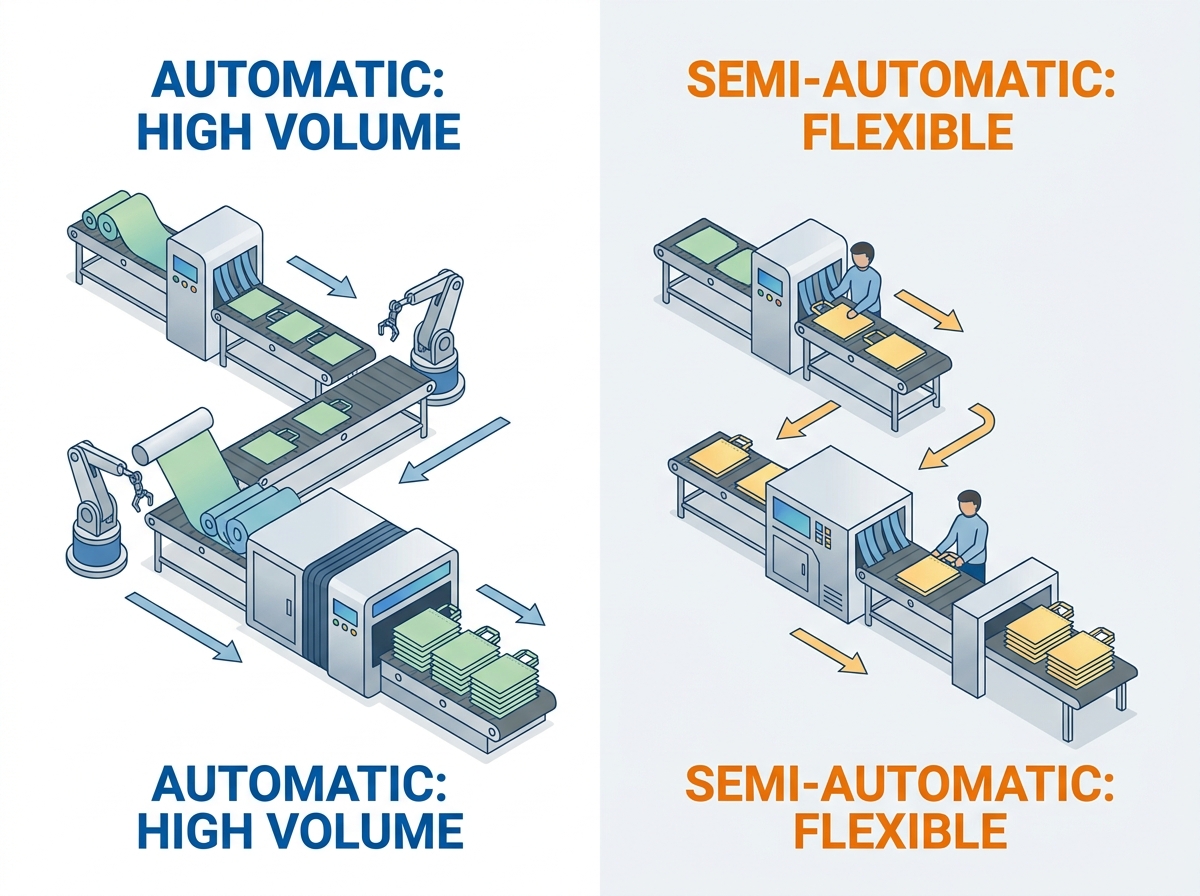
Semi-automatic manufacturing takes a modular approach. Instead of one continuous line, the process is divided into separate, specialized workstations. This setup relies heavily on human operators to move materials between stages, align fabric edges, and execute specific assembly tasks.
The semi-automatic workflow breaks bag making down into discrete steps. You deploy different standalone machines for different functions, allowing for a highly customizable factory floor layout.
Sheet Cutting: A dedicated roll-slitting machine unwinds the fabric and cuts it into precise rectangular sheets. The operator programs the length, and the machine rapidly slices the roll into flat panels.
Manual Folding and Punching: Operators manually fold the sheets according to the required bag dimensions. For D-cut bags, workers use a separate hydraulic or pneumatic punching machine to stamp out the handle holes. This requires an air compressor capable of maintaining 0.6 to 0.8 MPa of pressure.
Edge Sealing: Workers feed the folded edges through a standalone ultrasonic sewing machine. This machine looks like a traditional industrial sewing machine but uses a rotating ultrasonic wheel and a stationary horn to weld the seams as the operator guides the fabric.
Handle Attachment: Operators use a manual ultrasonic spot-welding machine to attach handle loops to the bag body. They position the handle, press a foot pedal, and the pneumatic horn descends to weld the joint.
This modular nature relies entirely on human operators. Workers must align the edges perfectly before feeding them into the ultrasonic sealers. They physically transfer work-in-progress batches from the cutting table to the sealing stations. Operators also perform continuous, manual quality checks at every stage, discarding defective pieces immediately.
Semi-automatic setups offer a distinct hybrid manufacturing advantage. You can easily combine ultrasonic body sealing with traditional industrial sewing for the handles.
Many clients require heavy-duty bags for carrying heavy loads, such as wine bottles, hardware, or agricultural products. Standard ultrasonic handles might fail under extreme stress. In a semi-automatic workflow, you simply route the bags to a traditional sewing station where operators stitch reinforced cross-patterns onto the handles using heavy-duty nylon thread. This flexibility is impossible on a standard fully automatic line.
Semi-automatic setups serve completely different market segments. They are the standard choice for manufacturing startups entering the market with limited capital. Bespoke packaging suppliers rely on them to produce highly customized, unique bag shapes that automated machines cannot handle.
If your business model focuses on short-run promotional orders—like 5,000 custom bags for a corporate event or a local boutique—semi-automatic machines are ideal. They are also highly profitable in regions with low labor costs, where hiring a large manual workforce is more economical than financing automated robotics.
The primary risk of semi-automatic production is inconsistent output quality. Because operators manually align the fabric, human fatigue leads to crooked seams, varying bag dimensions, and missed handle placements. Production speeds are also significantly slower, creating potential bottlenecks during peak order seasons.
To mitigate these risks, you must implement rigorous quality control checkpoints. Inspect the first and last bag of every batch. Design ergonomic workstation layouts to minimize unnecessary operator movement and reduce fatigue. Ensure adequate lighting at the ultrasonic sewing stations. Standardized training programs are essential to ensure all workers feed the fabric at a consistent pace and maintain straight lines.
You must also monitor the hidden long-term operational expenses. As your production volume scales, your headcount requirements scale linearly. Managing a massive manual workforce introduces complexities regarding human resources overhead, shift scheduling, and turnover.
Choosing the right equipment requires a direct comparison across critical operational metrics. You must evaluate how each system performs under real-world factory conditions, factoring in speed, labor, and facility constraints.
Speed is the most obvious differentiator. A fully automatic machine operates at high velocity. Depending on the bag size and complexity, automatic lines produce between 60 and 120 bags per minute. This continuous output allows you to fulfill massive contracts under tight deadlines. It prevents order backlogs and keeps your supply chain moving.
Semi-automatic production is fundamentally slower. The speed depends entirely on operator skill and the complexity of the bag. A highly skilled operator at an ultrasonic sealing station might process 15 to 30 bags per minute. However, because the process is modular, the overall output is limited by your slowest workstation. Fulfilling a one-million-bag contract using semi-automatic methods requires a massive facility and hundreds of workers.
Your profit margin per bag shifts dramatically depending on your scale and equipment. Fully automatic machines represent a high capital expenditure but deliver a very low operational expense per unit. Once the machine is running, the labor cost per bag drops to fractions of a cent. At high volumes, this maximizes your profit margins and allows you to compete aggressively on price.
Semi-automatic machines represent a low capital expenditure but carry a high operational expense per unit. You pay wages for every hour of production. For short runs, the high profit margin of custom bags absorbs this labor cost. However, if you attempt to produce standard supermarket bags on semi-automatic equipment, the labor costs will destroy your margins. You cannot compete on price against a fully automated competitor for commodity bags.
Automation changes the type of labor you need. A fully automatic line requires only one or two operators. However, these operators must be highly trained. They act as machine technicians. They must understand PLC programming, web tension dynamics, and basic pneumatic troubleshooting. Their primary job is monitoring the system, adjusting sensor parameters, and clearing finished batches.
Semi-automatic production requires a larger team of manual laborers. The skill barrier to entry is lower. You can train a worker to operate a manual ultrasonic sealer or a pneumatic puncher in a few days. However, managing a team of 20 to 50 manual laborers requires strong floor supervisors, strict attendance tracking, and constant quality oversight to prevent batch rejections.
Flexibility is where semi-automatic systems dominate. If a client orders 2,000 flat bags, followed immediately by 3,000 gusseted bags, a semi-automatic facility adapts instantly. Operators simply change their folding technique. The mechanical adjustments to the standalone sealing machines take minutes. You can switch production runs multiple times a day without losing significant output.
Fully automatic machines struggle with frequent changeovers. Switching bag styles requires mechanical downtime. Technicians must physically unbolt and replace folding triangles. They must adjust the position of the ultrasonic horns, swap out the anvil rollers, and recalibrate the photoelectric sensors. A complex changeover can halt production for two to four hours. Automatic machines are built to run the same bag size for days or weeks at a time.
Efficiency looks different in both systems. Automatic systems achieve high yield through continuous material flow. You maximize efficiency by preventing machine jams. You use high-quality fabric, maintain perfect web tension, and keep the ultrasonic horns clean. When the machine runs uninterrupted, yield approaches 99%, with waste limited only to the initial roll threading.
Semi-automatic systems achieve efficiency through optimized human workflow. You must reduce operator fatigue. Position raw materials within easy reach. Minimize the physical transfer times between the cutting, folding, and sealing stations. Yield depends on keeping the workforce motivated and minimizing handling errors during the manual alignment phases.
A fully automatic machine requires a significant, dedicated footprint. The continuous line can stretch 10 to 15 meters long. It requires heavy-duty flooring to absorb vibrations and usually demands a three-phase industrial power supply to drive the large servo motors and multiple ultrasonic generators simultaneously.
Semi-automatic workstations offer layout flexibility. You can arrange the standalone machines to fit awkward floor plans. You can easily add or remove stations as needed. Many of these smaller machines operate on standard single-phase power, making them suitable for smaller industrial units, converted warehouses, or startup facilities without heavy industrial electrical infrastructure.
Evaluation Metric | Fully Automatic Machine | Semi-Automatic Setup |
|---|---|---|
Production Speed | 60 - 120+ Bags Per Minute | 15 - 30 Bags Per Minute (Operator dependent) |
Labor Requirement | 1-2 skilled PLC technicians | Multiple manual operators per shift |
Changeover Agility | Slow (2-4 hours for mechanical adjustments) | Fast (Minutes for manual re-routing) |
Ideal Output Type | Standardized, mass-volume commodity bags | Custom, bespoke, and heavy-duty sewn bags |
Power Requirement | Three-phase industrial power | Often single-phase compatible |
Selecting the right machinery is not about finding the objectively superior machine. It is about finding the exact mechanical match for your specific business model. Use this strategic framework to audit your current operations and future goals.
You must establish a clear volume threshold. Analyze your monthly sales projections. If your target market demands high volumes of standardized bags—for example, exceeding 500,000 units per month—a fully automatic system is mandatory. You cannot hit those numbers profitably with manual labor. The machine will pay for itself through sheer volume and labor savings.
If your business model focuses on fulfilling smaller, varied orders of 5,000 to 20,000 bags for local boutiques, events, or promotional companies, a semi-automatic setup is the logical choice. The volume does not justify the capital expense of full automation, and the frequent changeovers would render an automatic line highly inefficient.
Map your local labor market. Calculate the true hourly cost of a manual worker, including wages, benefits, and administrative overhead. Factor in local turnover rates. High turnover means constant retraining, inconsistent quality, and disrupted production schedules.
If manual labor is expensive or scarce in your region, automation is a survival requirement. The high upfront cost of an automatic machine pays for itself rapidly by eliminating expensive payroll. Conversely, if you operate in a region with abundant, low-cost labor, semi-automatic setups allow you to scale production capacity with minimal financial risk.
Many successful manufacturers employ a phased scaling strategy. They do not choose one technology forever. They evolve as their client base matures and their capital reserves grow.
You can start with a semi-automatic setup to build your initial client base. This keeps your startup debt low. You use the flexibility to test different bag styles and find your most profitable niche. As you secure large, recurring anchor clients, you reinvest those profits into a fully automatic line dedicated solely to those high-volume orders.
You do not discard the semi-automatic machines. You keep them operational to handle custom, short-run, or heavy-duty sewn orders that the automatic line cannot process efficiently. This hybrid facility approach maximizes both scale and agility, allowing you to say yes to almost any client request.
Take the following steps to finalize your equipment strategy:
Audit your factory floor space and verify your electrical infrastructure for three-phase power compatibility.
Calculate your exact local labor costs against the monthly financing rates of automated equipment.
Request physical sample bags from equipment vendors to inspect the ultrasonic seal quality under stress.
Schedule technical demos to test your preferred fabric GSM on their machines and measure actual changeover downtime.
A: The investment difference is driven by engineering complexity. Automatic machines require advanced PLC touchscreens, servo motors, inline web tension controllers, and synchronized rotary cutting systems. They also feature complex inline handle attachment mechanisms. Semi-automatic machines are simpler, standalone units relying on basic motors and manual operation, making them significantly cheaper to manufacture.
A: A fully automatic line typically requires only one to two operators. Their primary duties include loading heavy fabric rolls onto the unwinding station, monitoring the PLC touchscreen for error codes, adjusting web tension, and boxing the finished bundles of bags as they exit the conveyor.
A: Yes, but it requires multiple steps and separate machines. For D-cut bags, operators use a standalone hydraulic punching machine to cut the handle holes after the bag is sealed. For handle bags, workers use a manual ultrasonic spot-welding machine to attach the pre-cut handle loops one by one.
A: Semi-automatic setups are best for sewing. While automatic machines strictly use ultrasonic welding, a semi-automatic workflow allows you to route bags to traditional industrial sewing machines. This is essential for creating heavy-duty, load-bearing bags that require reinforced, stitched handles.
A: A semi-automatic setup is generally better for startups. It requires significantly less initial capital, reducing financial risk. It also provides the flexibility to produce various bag styles and sizes, allowing a new business to test unproven markets and accept diverse, small-batch custom orders.
A: Changing bag sizes on an automatic machine can take anywhere from two to four hours. Technicians must mechanically adjust the folding triangles, swap out gusset plates, realign the ultrasonic sealing horns, and reprogram the cutting lengths in the PLC to ensure perfect synchronization.
A: Yes, both systems primarily rely on ultrasonic sealing technology to weld the nonwoven fabric seams without thread or glue. However, semi-automatic setups offer the added flexibility to integrate traditional industrial sewing for specific components, like handles, depending on the client's strength requirements.